
Briefing: The Complete Guide to Meaning, Types, Uses, and Modern Importance
Introduction
A briefing is one of the most powerful communication tools used across industries today. Whether in government, business, education, or media, a briefing helps deliver essential information quickly and effectively. In a world where time is limited and decisions must be made fast, the ability to communicate clearly and concisely is critical.
This article explores the full concept of briefing, including its meaning, history, types, structure, and real-world applications. It also connects related concepts such as “answer the following questions in brief” and “give a brief character sketch of Maddie”, showing how the idea of brevity plays a vital role in communication and education.
What is a Briefing?
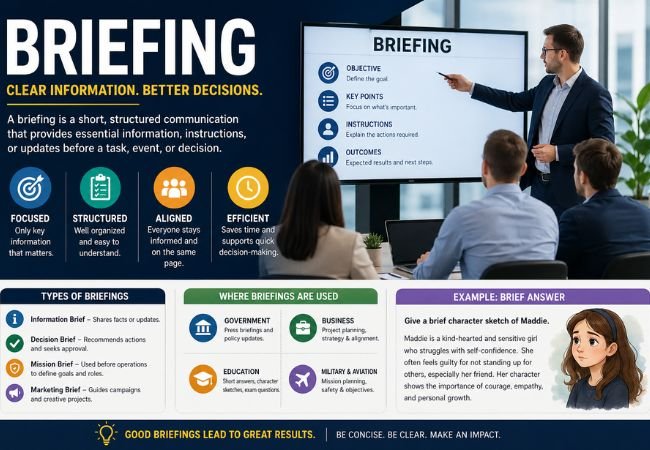
A briefing is a short, structured communication designed to provide key information, instructions, or updates before a task, event, or decision. It focuses only on the most important points, avoiding unnecessary details.
Key Characteristics of a Briefing
- Clear and concise
- Purpose-driven
- Time-efficient
- Informative and actionable
- Structured for easy understanding
A well-prepared briefing ensures that everyone involved understands what needs to be done and why.
History and Origin of Briefing
Early Development
The term “briefing” comes from the word “brief,” meaning short or concise. It was first used in the early 20th century and gained popularity in professional environments.
Military Influence
Briefings became especially important in military operations, where soldiers needed quick and accurate information before missions. These briefings included:
- Objectives
- Strategies
- Risks and safety instructions
This structured approach later influenced how briefings are used in business and government today.
Types of Briefings
1. Information Brief
An information brief provides facts or updates without requiring any decision. It is commonly used in daily reports or news updates.
2. Decision Brief
A decision brief presents analysis and recommendations and asks for approval or action from a leader.
3. Mission Brief
A mission brief is used before an operation. It outlines goals, roles, and expected outcomes. This type is common in military and aviation.
4. Creative or Marketing Brief
This type is used in business to guide campaigns and projects. It includes:
- Target audience
- Objectives
- Brand tone
- Key messages
5. Educational Brief
In education, brief responses are often required. For example:
- Answer the following questions in brief
- Answer the following question in brief
These instructions encourage students to focus on essential points and avoid unnecessary explanation.
Structure of an Effective Briefing
1. Objective
Clearly state the purpose of the briefing. What needs to be achieved?
2. Background
Provide context to help the audience understand the situation.
3. Key Points
Highlight the most important information. Keep it concise and relevant.
4. Instructions or Recommendations
Explain what actions need to be taken or decisions to be made.
5. Conclusion
Summarize the main points and reinforce the objective.
Importance of Briefing in Modern World
1. Saves Time
Briefings eliminate unnecessary details and focus only on what matters.
2. Improves Decision-Making
Leaders can make faster and better decisions with clear information.
3. Enhances Communication
It ensures that everyone receives the same message.
4. Reduces Confusion
A structured briefing minimizes misunderstandings and errors.
Briefing in Education
Briefing concepts are widely used in academic settings.
Answer the Following Questions in Brief
Students are often asked to provide short answers that include only key points. This improves:
- Understanding
- Clarity
- Writing skills
Give a Brief Character Sketch of Maddie
This type of question requires a concise description of a character. For example:
Brief Character Sketch of Maddie
Maddie is a kind-hearted and sensitive girl who struggles with self-confidence. She often feels guilty for not standing up for others, especially her friend. Her character represents the importance of courage and empathy. Through her actions and thoughts, Maddie shows personal growth and a deeper understanding of right and wrong.
This example shows how briefing skills help in summarizing complex ideas effectively.
Briefing in Business and Corporate World
In business, briefings are essential for:
- Project planning
- Team alignment
- Strategy communication
Marketing Brief Example
A marketing team may receive a briefing that includes:
- Campaign goals
- Target audience
- Budget
- Timeline
This ensures that all team members work toward the same objective.
Briefing in Government and Media
Press Briefings
Governments use press briefings to:
- Share updates
- Inform the public
- Address important issues
Media Briefings
Journalists rely on briefings to quickly understand events and report them accurately.
Briefing vs Detailed Communication
| Aspect | Briefing | Detailed Communication |
|---|---|---|
| Length | Short | Long |
| Focus | Key points | Full explanation |
| Purpose | Quick understanding | Deep analysis |
| Usage | Meetings, updates | Reports, research |
Common Mistakes in Briefing
1. Too Much Information
Including unnecessary details defeats the purpose of a briefing.
2. Lack of Structure
Unorganized information can confuse the audience.
3. Unclear Objective
Without a clear purpose, a briefing loses effectiveness.
4. Ignoring Audience Needs
A good briefing must be tailored to the audience.
How to Write a Powerful Briefing
Step 1: Understand the Purpose
Know why the briefing is needed.
Step 2: Identify Key Information
Focus only on essential points.
Step 3: Organize Clearly
Use headings and bullet points for clarity.
Step 4: Keep it Concise
Avoid unnecessary words or details.
Step 5: Review and Refine
Ensure clarity and accuracy before presenting.
Quick Info About Briefing
- Meaning: Short and focused communication
- Origin: Derived from the word “brief”
- First Known Use: Early 20th century
- Common Fields: Military, business, education, media
- Purpose: Provide essential information quickly
FAQs About Briefing
1. What is a briefing in simple words?
A briefing is a short explanation or set of instructions given before a task or decision.
2. Why is briefing important?
It saves time, improves communication, and helps in better decision-making.
3. What are the main types of briefings?
Information brief, decision brief, mission brief, and marketing brief.
4. What does “answer the following questions in brief” mean?
It means giving short and clear answers that include only the main points.
5. How do you write a good briefing?
Focus on clarity, structure, and essential information while keeping it concise.
Conclusion
A briefing is more than just a short message—it is a strategic tool that enhances communication, efficiency, and decision-making. From classrooms to corporate offices and government institutions, briefing plays a vital role in delivering information effectively.